Jiu Jitsu for Beginners: Why Slowing Down Helps You Improve Faster
Most beginners try to get better at Jiu Jitsu by going faster, but this is one of the biggest mistakes you can make.
If you are new to Jiu Jitsu, you will often hear your coach say things like, "Slow down," or, "Don't roll so hard." That can feel confusing. Jiu Jitsu is a combat sport, and sparring, the live application of technique, is how we improve. So why would slowing down help you get better?
Because as a beginner, you are not just learning techniques. You are learning how to exist in an entirely new environment.
You are learning how classes flow, the culture of the room, how to work with training partners, and an entirely new framework for movement and self-defense. That is a tremendous amount of information to process all at once. Before you can apply technique effectively, your brain needs time to absorb what is happening.
When everything feels fast and unfamiliar, you naturally become more reactive. Instead of observing, recognizing patterns, and making intentional decisions, you are simply responding to whatever happens next. You may still move, scramble, and work hard, but your ability to understand what is happening—and improve from it—is limited.
You can't learn to swim when you're drowning.
Slowing down creates the conditions for learning. At a controlled pace, you can recognize positions, understand cause and effect, and make deliberate decisions. This is how real skill is built in beginner Jiu Jitsu training—through clarity, not chaos.
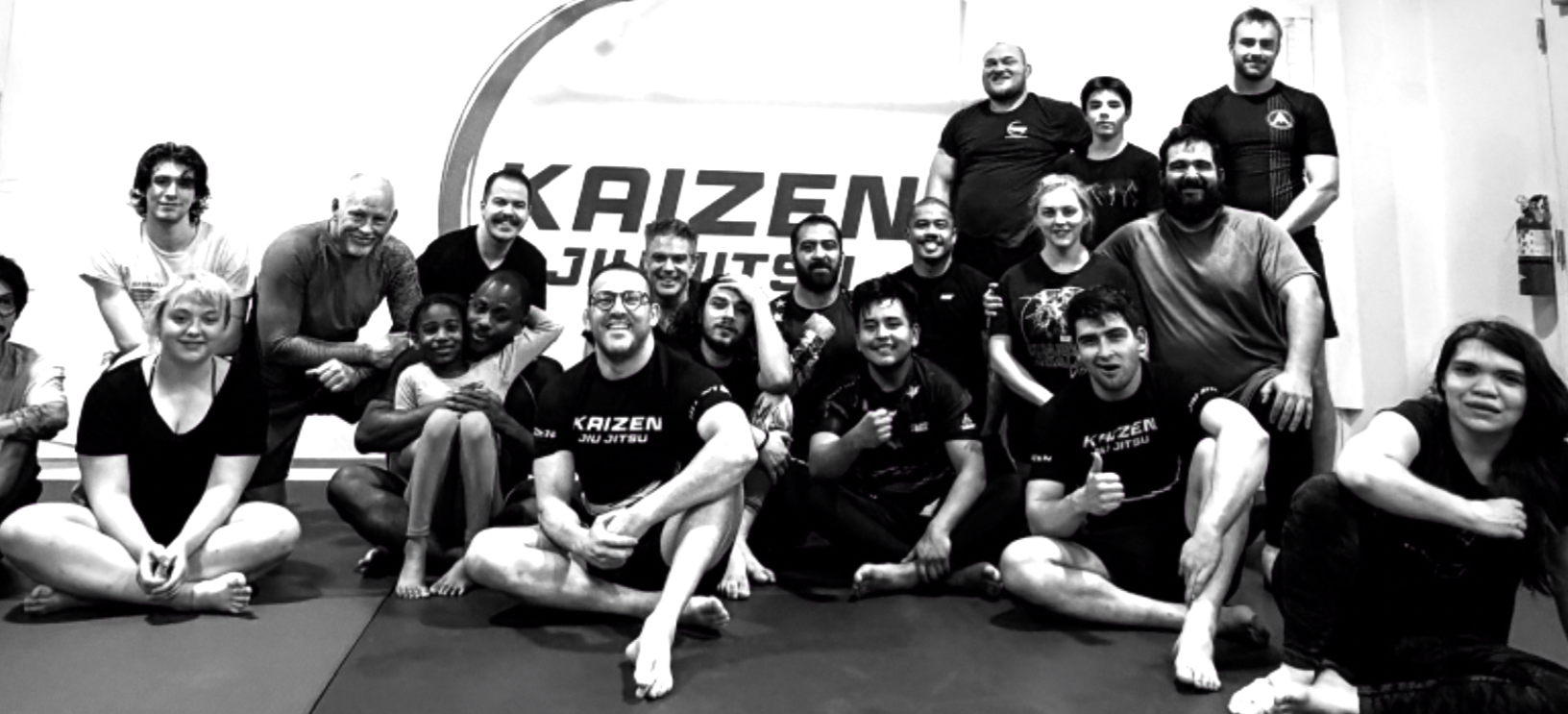
Everyone in this photo was new once.
There is also a biological reason for this. As stress and intensity increase, the prefrontal cortex—the part of the brain associated with conscious decision-making and problem-solving—becomes less active. At the same time, more reactive processes associated with the limbic system begin to take over. When that happens, it becomes more difficult to process information, solve problems, and form clear memories of what occurred during training.
A simple way to evaluate your pace is to ask yourself what happened during the round.
Can you explain it?
If you can say, "I pulled guard, attempted a sweep, and we scrambled back to our feet," your brain was actively engaged in the learning process.
If your answer is, "I don't really know what happened," the intensity may have been too high for you to effectively process the experience.
That does not mean learning stops. Automatic learning systems responsible for movement and habit formation are still at work. However, beginners benefit most when they can combine those systems with conscious understanding of positions, techniques, and decision-making.
The goal in Jiu Jitsu training is not to eliminate intensity. The goal is to manage it.
You want enough resistance to make training realistic, but not so much that it overwhelms your ability to think and learn.
Over time, controlled training builds patterns that become automatic. As those patterns develop, speed and intensity can increase without sacrificing clarity.
At Kaizen Jiu Jitsu, this is a core principle: beginners improve faster when they train with intention, not just effort.
If your coach is telling you to slow down, it is not a limitation. It is direction.
You are not being held back—you are being shown how to build skills that will actually last.
Slowing down is not about making training easier. It is about making training more effective.
Speed will come.
But it should come from clarity, not chaos.